Lessons from viral vectors, CAR-T, & RNA
Blog PostPhage production has its quirks, but it’s not the only field trying to reliably manufacture a new biological entity. This week I share learnings from Australia’s annual bioprocessing conference about challenges other fields are facing, and what we might borrow as we prepare phages for the clinic.
Therapeutic phage production has a lot of quirks, but it’s not the only field trying to biomanufacture a new biological entity that doesn’t fit traditional paradigms. CAR-T, cell-based meat, precision fermentation, RNA, viral vectors, exosomes — there’s plenty of weird and wonderful biologics in the global pipeline, plenty of lessons we can learn from each other, and (in the spirit of thanksgiving), even some reasons to be grateful we work with phages.
Last month, I went to Australia’s BioProcessing Network’s annual meeting to present about Phage Australia’s phage production pipeline, and to learn as much as possible about the challenges other biomanufacturing fields are facing.
Usually I go to phage meetings, but going to a biomanufacturing meeting really helped me put phage challenges into context within the biomanufacturing space at large. It was great to see the landscape of potential problems we may face (or are lucky not to… yet?), and see how others are solving them.
Here’s a window into my thoughts and learnings.
We’re not (that) special
The phage field has been saying a version of ‘we don’t fit the traditional drug development model’ for a while (or at least I have been saying it for years!). Yes, it’s hard to make phages; they don’t behave like ‘simple chemicals’, and scaling is hard because it’s personalized. But what I’m learning is that the phage field is really not that special in this regard. (Yay! This makes our lives easier!).
You don’t have to look far to find other wild and crazy examples of biological things people are making, which are also not ‘simple chemicals’. CAR-T cells are cancer drugs made from patient cells, that have to be taken out of the patient, manipulated in the lab, then cleaned up and put back into the patient. It’s personalized, so you need to make many small batches, and because you can’t rely on treating a million people per drug, pricing gets interesting. RNA vaccines have to be made, (and made not to degrade), stuffed into lipid droplets, and scaled up to MILLIONS of doses. Cell-based meat companies are trying to brew animal muscle cells like beer, make them 3-dimensional and not taste gross, and again, scale to the high heavens so it’s all cheap enough to compete with Chick-Fil-A. We phage-makers are not alone in having manufacturing/scaling struggles.
Phages are lucky in a few ways
When I went to Australia’s BioProcessing Network conference last month, I didn’t expect to come away with the sense that the phage field actually has it easy in a few ways. But after my talk on our process and challenges at Phage Australia, people kept coming up to me and saying things like ‘wow, you guys can get 4000 doses from 300 mL?’, ‘oh you can filter-sterilize, so you don’t need everything to be sterile in your manufacturing process — jealous!’, and ‘wow, the phages are that stable? Our viral vectors start dropping in titre within hours’.
Neat! We have something that’s small enough to separate from contaminants using a basic filter, they’re quite safe, they grow to high titres, they treat disease so we can theoretically command more than $1 per litre (sorry cell-based meat people, that sounds hard). They don’t generate warehouses full of spent media/dead (GMO) yeast cells. And yet, plenty of companies in these fields get funding to scale up (ie. they’re not ‘too complicated’ / ‘too non-traditional’ / ‘too risky’. So maybe phage labs/companies can do the same?
Here’s a table showing a quick overview of lucky phage traits and comparisons to other entities:
| Beneficial phage trait | Compared to... | Overheard at the conference |
| Small | CAR-T | "Large size means you can’t filter-sterilize" |
| Doesn’t rapidly lose activity | Viral Vectors, T-Cells | “10% drop in activity every 4 hours", “Need to sample process throughout, watch for viability crash"" |
| Stays the same size | Nucleic acids, ie. RNA | "Nucleic acids supercoil differently in different salts, so their size changes, which makes TFF challenging" |
| Small doses can still be valuable | Cell-based meat | "Need to achieve $1 per litre… you can barely make water for that" |
| Production doesn’t generate massive (GMO) waste | Precision fermentation, e.g. synthetic milk | "Need to find a way to dispose of our waste, including massive volumes of GMO yeast" |
Take what you will from this; it’s no fun to hear that our challenges are “less bad than others’ challenges”, but I’m thinking maybe we can leverage this to de-risk our phage manufacturing plans in chats with investors…? Which brings me to my next point…
The phage field is also unlucky: we have less money
It’s of course not all roses of the phage field. We’re not treating cancer (at least not directly), so we can’t really command $500,000+ per treatment like CAR-T. We have to go through drug rather than food pathways, unlike meat and synthetic milk, so it’s expensive to do. And no one wants to pay much for designer antibiotics, especially ones you can’t easily patent-protect. But we already knew this…
Many of our needs are shared with more well-funded fields
It’s hard to be alone with your unique challenges. But since we’re not, we can benefit in a few ways!
We can buy the products designed for those fields
When you don’t have much money, no one makes products for you. But it helps if other richer fields need the same things. Viral vectors (used for gene therapy) are made similarly to phages. They need to be filtered and cleaned. They use tangential flow filtration just like we do. (So do the RNA people!). And they have all have lots of funding right now. As a result, there are tons of vendors and products (like Cytiva’s AKTA Flux which I wrote about here) on the market to do this, and we can benefit from these tools. And the more these fields grow, the cheaper and more diversified the tools become.
We can glimpse potential future problems & adapt solutions
Getting around salt sensitivity: Viral vector people have issues with salt, which is sometimes used to elute viruses from columns (to solve, they dilute the product immediately after eluting).
Getting rid of empty capsids: Viral vector people have figured out how to use chromatography to separate full viral capsids from empty ones; they use anion exchange columns. We will probably need this for phages (since empty capsids are potentially immunogenic but don’t help the patient), so let’s use their methods and test the exact same columns to start.
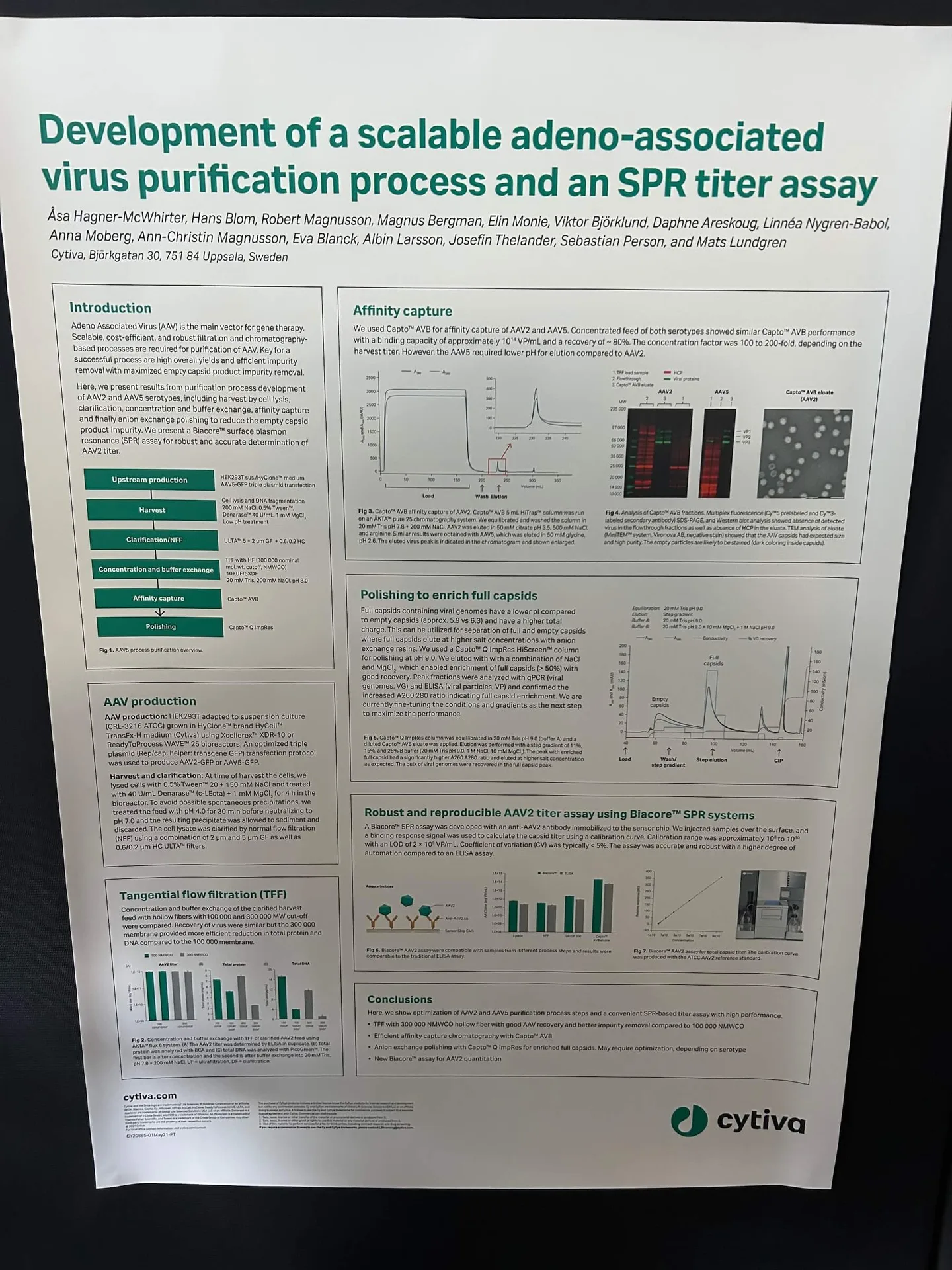
Fig 1. This Cytiva poster showed how empty vs. full viral vectors can be separated. I know you can’t really read it, but using it to illustrate the point that there’s plenty of tangible knowledge to gain from these other fields at conferences like these.
Tangential flow filtration: RNA people and viral vector people are using this for buffer exchange (instead of dialysis to clean out media components), which I’ve already fallen in love with for phage purification. The company Southern RNA develops methods for TFF and gave a great talk about all the troubleshooting they’ve done.
Membrane columns: Could be another thing for us to try; larger pores (rather than beads which have small pores) are good for capturing large things like phages. I was consistently pointed to this poster and Sartorius’ products for this.
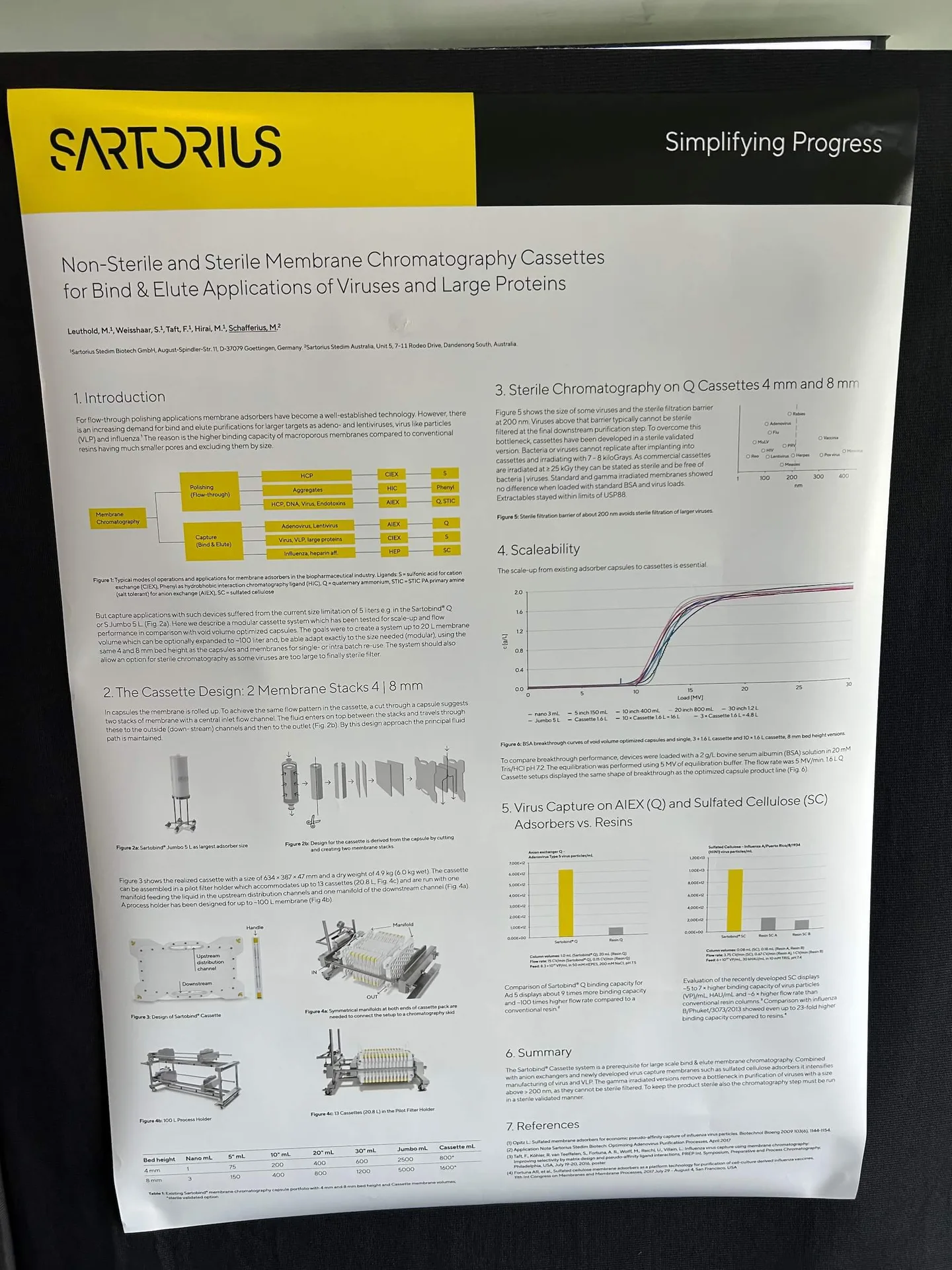
Fig 2. This Sartorius poster shows how ‘membrane chromatography’ can be great for viral purification. Again, I know you can’t really read it; definitely check out the company website if you’re itching to try this.
Alternatives to plaque assays: Viral vector people add viruses to host cells and measure how many transduce. They then (as I understand it currently) use flow cytometry of these infected cells to quantify their viruses. Obviously not directly useful when we’re dealing with lytic phages. But flow cytometry is much quicker than plaque assays, and this made me think we should try using flow cytometry for phage counting (it’s been done before, but rumour has it, they’re too small to reliably detect this way).
I also saw a poster about someone using dynamic light scattering to quantify/estimate activity of viral particles, which made me think of this new paper from the Bollyky lab I still need to sit down with!
We can copy their quality management practices
I’ve talked before about how I’m working with the Sydney Cell and Gene Therapy centre here at Westmead Institute to ‘GMP-ify’ our processes. This has been the best hack! I found even more people like this at the biomanufacturing conference; plenty of consultants who specialize in quality, GMP, etc. And a lot of it is highly transferrable from one product to another (since we’re all making things safely for the same final entities: humans, animals, and the environment).
We can look in these fields for people/professionals to help us
CROs: There are lots of CROs set up to do bioprocessing. We can use them too (if we can convince them to let phages in the doors). We can also use CROs to outsource our quality steps, and leverage the same protocols the T-Cell, viral vector and RNA people use (they too have to demonstrate sterility and low endotoxin).
People: Instead of upskilling phage people for manufacturing and QC, we can hire people from these adjacent industries to help us manufacture and safety-check our phages. Plenty of people at the conference were super excited about our phage work, and would be happy to move from antibody production to something like phage.
More tidbits, trends & learnings
I saw a few interesting trends that could be relevant. I’ll leave them here in rapid-fire style, in no particular order:
AI for biomanufacturing: People are using AI to do ‘digital twin’ work, ie. simulate a chromatography run so you can avoid running experiments you don’t have to run. Lukas Gerstweiler, a Prof at University of Adelaide, did 3 months of work optimizing a milk bioprocessing process, and only 3 of those days were spent in the lab. There’s a Cytiva no-code version and an open source version called CADET.
Many underutilized biomanufacturing facilities: It seemed like a trend (at least in Australia) that universities/government will fund a facility before there’s anyone ready to use it. Maybe true in other places? There were at least 3 talks this year with people saying ‘come use our biomanufacturing facilities, they’re mostly empty’.
Ginkgo looking for partners: Ginkgo Bioworks is a big robot lab company and they’re looking for partners, but struggling (at least in Australia) because everyone wants to build everything themselves. Also it seems they collect everyone’s data (which they do leverage in part for their clients benefit), but from what I heard from conference-goers, they have trouble trusting a company that collects their data, because ‘data is king’.
Cytiva will send someone to your lab if you buy their systems: Realized since we bought Cytiva products (AKTA Flux, AKTA Pure), we can get (for free) a person to come work with our team to get our processes optimized. Not sure how far this goes but I like to accept free help!
VR for lab training is getting good: I spent a weirdly long time in Cytiva’s virtual reality ‘room’ doing a hands-on training on one of their bioprocessing instruments. It was really well done, and makes getting up to speed on these instruments/understanding how they really work seem a lot less daunting. Also, a pharma company from Melbourne called CSL later gave a talk on how they’re using VR for tech transfer (getting contract research organizations/collaborators to be able to reproduce their process without having to train them in person). So I came away thinking VR may be playing a role in our labs in less time than I thought.
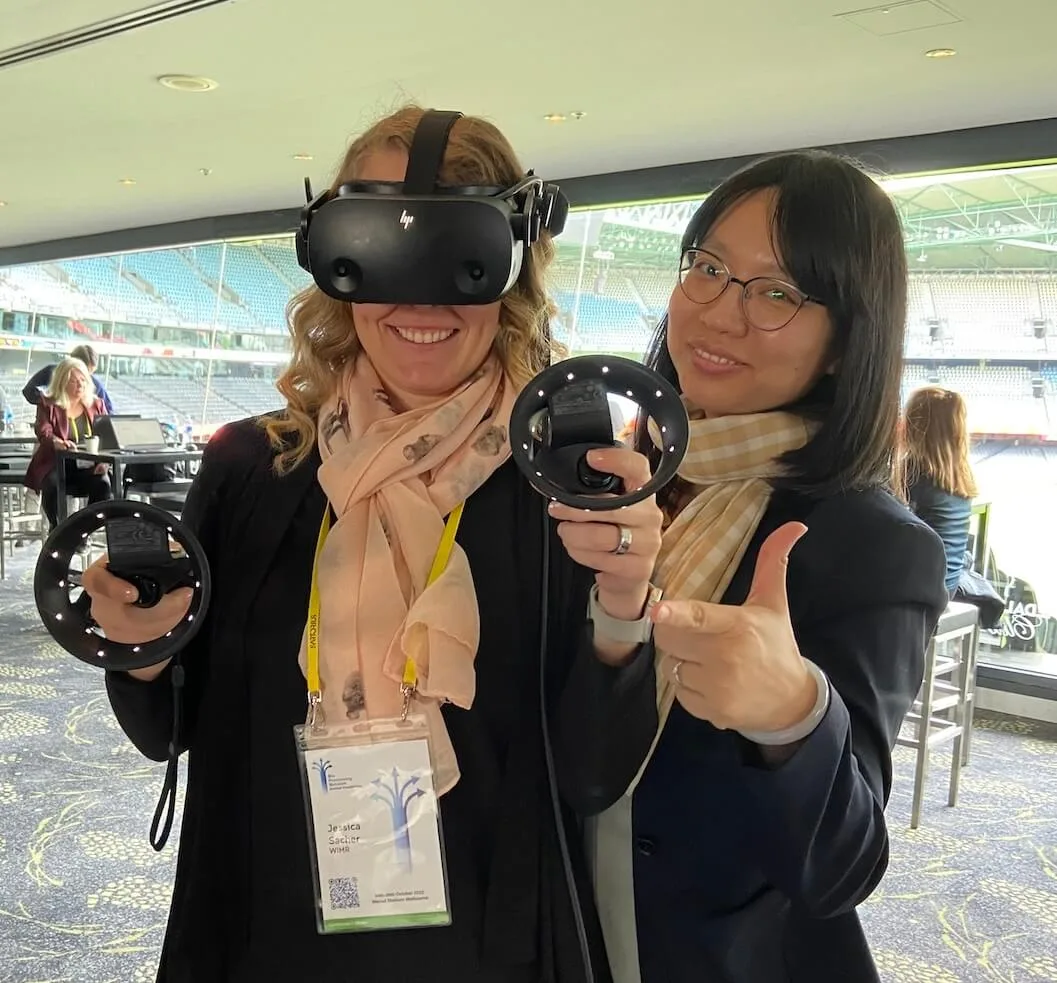
Fig 3. Me with one of Cytiva’s representatives, working through a virtual reality training module where it felt like I was really operating a massive bioprocessing instrument! I could actually reach out and touch things, feel like I was physically controlling the machine, picking up tools and tubing and attaching them.
‘Readiness levels’ are a common thing: Everyone kept talking about ‘technology readiness levels’ and ‘AI readiness levels’, and even ‘GMP readiness levels’ for labs/organizations. This was a cool concept we could maybe think about applying to phage labs… ‘phage manufacturing lab readiness levels’… level 1: the lab can isolate lab-grade phages. Level 2: can purify lab-grade phages. Level 3: can purify clinical grade-phages for single patients. Level 4: can manufacture GMP phage batches for multiple patients. Etc.
Exosome therapeutics are new kids on the block: Another cool area; just one talk on this and to be honest I missed it, but I need to check this out.
A ton to learn, and reasons for hope!
Overall what I’m learning is that we phage people are not alone in being ‘non-traditional’. Things are changing, and there’s a ton we can learn from other fields. Biomanufacturing/bioprocessing conferences are a good use of time for those of us trying to set up phage manufacturing systems and build phage therapy centres and companies. The viral vector people, the T-cell people, the cell-based meat people, the RNA people — they are out there tackling similarly unpredictable/messy/’non-traditional’ biological problems, and we should befriend them, copy them, learn from them, and point to them as examples when people (investors/funders) say ‘phage therapy sounds complicated/risky’! (In fact; maybe we should be talking to their investors…). We all hate reinventing the wheel, and want to move faster with better tools; looking to these other fields is a great way to do that. Plus, they think phages are cool, so it’s easy to make friends at their conferences!